Sandokan’s leadership of the Tigers of Mompracem
The Tigers of MompracemSandokan’s leadership of the Tigers of Mompracem is the force that turns the island’s armed refuge into an organized maritime power. He commands men ready to risk their lives at his signal, yet the narrative also shows a bond that is not merely disciplinary: he looks upon his assembled crew with tenderness, and their response to him is charged with enthusiasm. His authority therefore joins military command to personal allegiance, even as his own account of vengeance and the evidence of his generosity complicate what kind of leader he is.
Island Stronghold and Political Setting
Mompracem is both the home of the feared pirates of the South China Sea and the setting for Sandokan’s command. On the stormy night of December 20, 1849, ships lie sheltered in the bay while the island remains dark; above the sea, a large hut bears a red flag marked with a tiger’s head. The fortifications around the hut—trenches, embankments, and ramparts—make the setting more than a dwelling place. It is an armed headquarters, where the pirate leader’s emblem stands over a defended base.
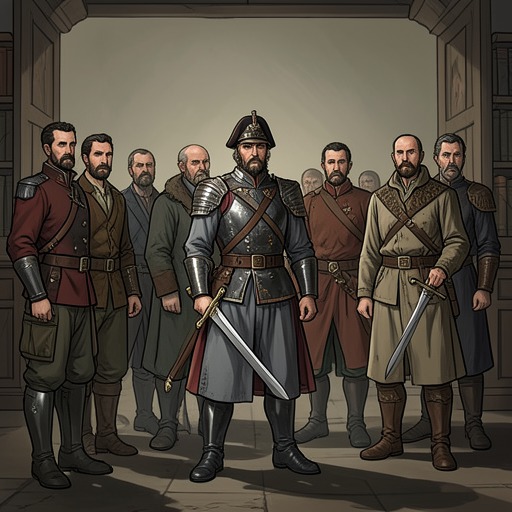
The scale of the force assembled there makes Sandokan’s individual authority visible. More than a dozen prahus are anchored close to shore, and three hundred men wait in formation before the longhouses for orders. They have come from across the east: among them are Malays, Batavians, Dyak, Cochin Chinese, Siamese, Indians, Bugis, Javanese, Tagalis, Filipinos, and Negritos. The variety of their origins gives the crew a broad composition, while their shared readiness for action gives it cohesion under one leader.
Mompracem’s armed presence also exists within a wider contest over control of the sea. The British occupy Labuan, seized in 1847 under orders to eradicate piracy from those waters, and have built Victoria Citadel to protect the island from raids associated with Mompracem. The fortified British position and Sandokan’s defended island base represent competing armed powers. Sandokan does not treat British activity as a distant political matter: he asks what the British are doing in Labuan and insists that they will not be allowed to challenge his stronghold without resistance.
Command and the Crew’s Allegiance
The crew’s response to Sandokan demonstrates the personal basis of his authority. When he appears before the three hundred men, excitement passes through their ranks and they raise their krises in salute. The account emphasizes that he looks at them tenderly before summoning his captain, Patan. This exchange presents command as both hierarchy and attachment: Sandokan can call upon a subordinate by name and issue orders, but the men’s salute and excitement show that his presence itself matters to them.
His orders are not open to debate in the moment. When one pirate asks where the ships are going, Sandokan replies that the man’s duty is to obey rather than question. The crew member turns away and goes with his men. The episode states the terms of the relationship plainly: Sandokan determines the objective, and the men carry it out. Yet the account immediately stresses that they are so bold and devoted that, at only a sign from him, they would not hesitate to sacrifice their lives. Their obedience is thus portrayed not as reluctant compliance but as a deep, dangerous loyalty.
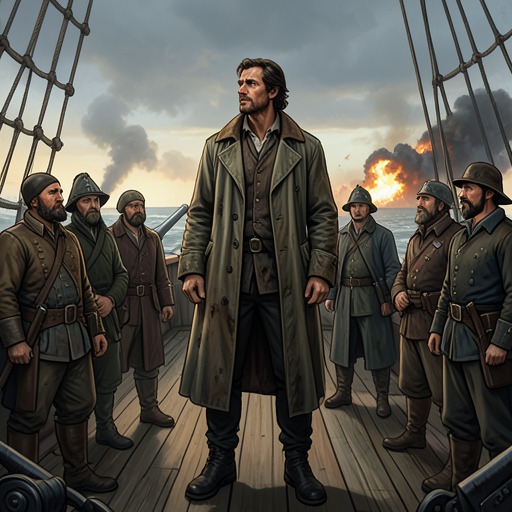
Sandokan’s command also reaches beyond the island gathering into coordinated action at sea. During the attack on a junk whose crew raises a flag bearing James Brooke’s emblem, he identifies the connection to the Rajah of Sarawak and orders an assault. Patan moves to the bow cannon as the other pirates prepare their rifles and carbines. When the fight turns against the boarding party, Sandokan leads from the front, climbing aboard the junk and calling his men to him. They follow across the vessels and join the attack. The scene presents leadership as a combination of strategic decision, direct participation, and an ability to rally the crew under immediate pressure.
Vengeance, Protection, and Reward
Sandokan explains his hostility to European powers through his own history as he recounts it to Yanez. He says that Europeans conspired to take his throne because he had become too powerful, and that they murdered members of his family and others he loved. He presents his raids and his vow of revenge as a response to that persecution, naming Spanish, Dutch, British, and Portuguese powers among the enemies against whom he has sworn to act. This is Sandokan’s stated justification, not a neutral account of every consequence of his campaigns; the narrative places it beside his record of raids and the danger his forces pose to their opponents.
Yanez offers a counterweight to a portrait based only on vengeance. He recalls Sandokan defending poor communities against raids, returning captive women to enemy ports despite the danger from British cruisers, and rescuing people stranded on wreckage during storms. Yanez also says Sandokan gave rescued survivors substantial riches. These examples broaden the meaning of his authority: his reputation among the crew is joined to a record, as Yanez describes it, of using his power for people in need. The contrast is not resolved into simple innocence. Sandokan remains a pirate leader who attacks and plunders, while the account also identifies protection and generosity as recurring parts of his conduct.
The encounter with the junk’s captain makes that tension concrete. After the vessel has been destroyed, Sandokan offers the captain a string of diamonds, saying they will pay for ten new junks and expressing regret for the loss. He then identifies himself as the Tiger of Malaysia. The act couples a display of wealth and authority with compensation for an adversary whose vessel he has helped destroy. It does not undo the attack; rather, it shows how Sandokan’s leadership can encompass both force and a self-conscious gesture of restitution.
Leadership Against a Stronger Naval Force
The conflict with the British cruiser tests the collective identity Sandokan has built at Mompracem. When Giro-Batol reports that a cruiser blocks the river’s mouth, Sandokan treats the interception as a challenge and prepares the two crews to meet it. The men answer with a cry of allegiance to the Tiger and calls to attack. Their response echoes the excitement and raised weapons at the island muster: loyalty to Sandokan is repeatedly expressed through a readiness to fight at his command.
The danger is not abstract. The British ship is described as a heavily armed vessel of fifteen hundred tons, patrolling about six hundred metres from the coast and blocking the way westward. Sandokan studies it and recognizes that it is formidable, with a crew four times the size of his own. He nevertheless turns to his men and orders them to man the oars. The moment shows the limits and the reach of his leadership at once: his force is smaller, but his men remain organized around his decision to advance rather than retreat. The account establishes the challenge and their readiness, without making that readiness proof of an outcome beyond the scene.
The Meaning and Limits of His Authority
The relationship between Sandokan and his crew is defined by a striking conjunction: strict obedience, collective daring, and an emotional attachment that the narrative makes visible in gestures and response. His command is not shown as a formal political office; it is enacted through the force he has gathered, the orders he gives, and the men who carry them out. The island’s defenses, the anchored prahus, and the tiger emblem give that authority a material home, while the crew’s salute and battle cries give it a public voice.
At the same time, the narrative refuses to reduce Sandokan’s leadership either to terror or to benevolence. He invokes the family losses he attributes to European persecution and promises relentless revenge, yet Yanez recalls acts of rescue, protection, and generosity. In battle, Sandokan shares the danger and calls his men forward; toward the defeated junk captain, he offers diamonds even after destroying the vessel. These contrasts make his leadership morally charged rather than uncomplicated: the same power that directs raids can be represented as a defense of the weak, and the same commander who demands unquestioning obedience is associated with a personal ethic of aid and compensation. His crew’s loyalty binds those contradictions into a force capable of confronting the much larger powers around Mompracem.